
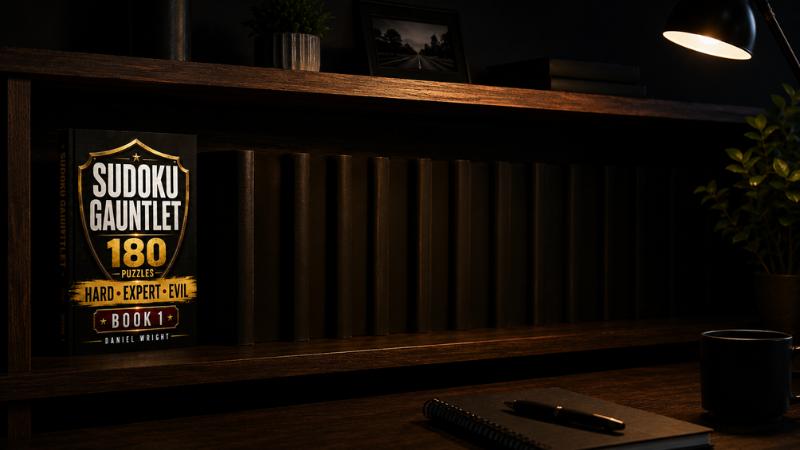
I thought I’d make a post about revisiting the Sudoku publishing project.
Originally, it was called Sudoku Depot, but that’s no longer the direction I’m taking. The website is gone, I’m dropping the name, and it’s no longer going to be used as a pen name. Ironically, that’s one of the things that caused me to put the project on hold back in January.
It’s now the end of June, almost July. During the last several months, I’ve been focused on other projects, especially building a Facebook page. Working on those projects made me realize something.
Time adds up.
I started thinking, “What if I had just published one Sudoku book every week?”
So I did the math.
If I had simply stuck to one book per week since January, I’d probably have somewhere around 23 or 24 books published by now.
That was a little painful to realize.
The funny thing is that actually creating the books isn’t the time-consuming part. Generating the PDF takes less than ten seconds. The real work is putting everything together, checking the formatting, creating the cover, and getting everything uploaded correctly. Even then, I honestly think I could finish a book in an hour or two on one of my days off if I stayed consistent. I should probably start timing the process just to see how long it actually takes.
The reason I stopped wasn’t because making the books was difficult.
It was because I ran into an issue with Amazon KDP.
I uploaded the first Sudoku Gauntlet book on the last day of 2025. About two weeks later, I uploaded Book 2. The first book was published under the pen name “Sudoku Depot,” and KDP approved it without any issues.
Then I uploaded the second book.
This time, KDP rejected the pen name, saying it was too confusing. What made it frustrating was that they had already approved it once. I had to create a different pen name, but after changing it, they wouldn’t let me go back and update Book 1. So I ended up with two books that weren’t consistent.
Today I finally decided to fix all of that.
I unpublished both books and updated everything so they’ll both use the same pen name going forward.
I also cleaned up Book 2. It still contained references to a Sudoku Depot website and newsletter that were never created. Since neither of those exists anymore, I removed all of that content. Now both books are consistent and point to the same author identity.
While I was making those changes, I revisited the cover for Book 1.
Honestly, I never liked it.
ChatGPT helped me create the original cover, but looking back, I don’t think the art direction was very strong. What’s interesting is how much AI image generation has improved over the past few months. I don’t know exactly when the update happened, but sometime this spring it felt like the quality took a huge leap forward.
I’ve noticed it not only with ChatGPT but with AI image generation in general. Things that were almost impossible to create a few months ago are now surprisingly easy. The technology is improving so quickly that you can sometimes notice the difference from month to month.
Today we created a completely new cover, and I’m much happier with it.
The next step is finishing the full wraparound cover. I’ll create the back cover, use Amazon’s KDP template to size everything correctly, then bring it into Canva to finish the spine. I used Book Bolt before, but I’m no longer paying for it, and I think Canva will handle everything I need.
I’m optimistic about how it’s going to turn out.
My goal tonight is to finish the cover and hopefully re-upload Book 1.
The bigger lesson, though, isn’t really about one book.
It’s about consistency.
When I realized I could have had over twenty books published by now, my first reaction was to be disappointed that I stopped. But after thinking about it, maybe stopping wasn’t entirely a bad thing.
If I had continued publishing, I would have ended up with a catalog of books that used inconsistent pen names, pointed readers to a website and newsletter that don’t exist, and had covers I wasn’t proud of.
Now I have the opportunity to rebuild the foundation correctly.
Instead of looking at the last six months as lost time, I’m choosing to look at them as a chance to reset the project the right way.
From here, the goal is simple.
One book every week.
That’s it.
If I stay consistent with that schedule, the catalog will grow on its own. The first two books never gained any traction, but that’s okay. Every book is another opportunity to learn something. Maybe it’s improving the cover. Maybe it’s choosing better keywords. Maybe it’s making small improvements to the interior.
Every book is another step forward.
The important thing is to keep publishing.
Six months from now, I’d rather look back and see twenty-four more books than realize I spent another six months thinking about what could have been.
